
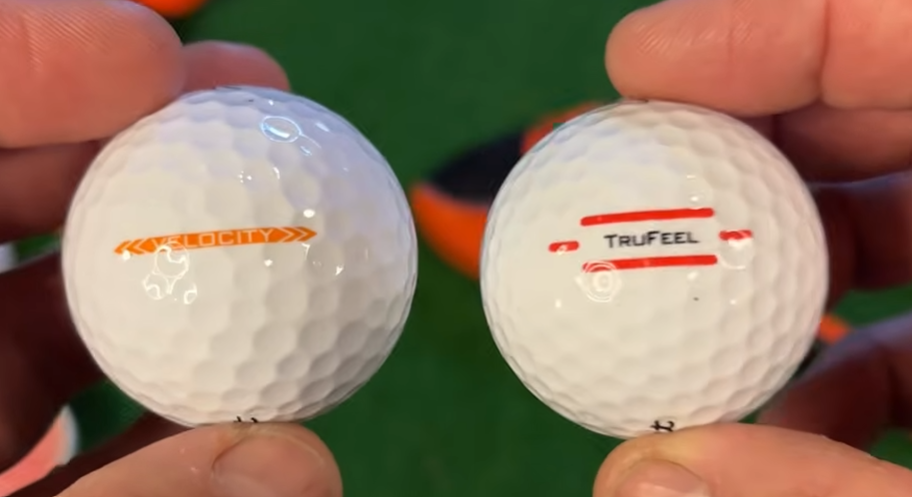
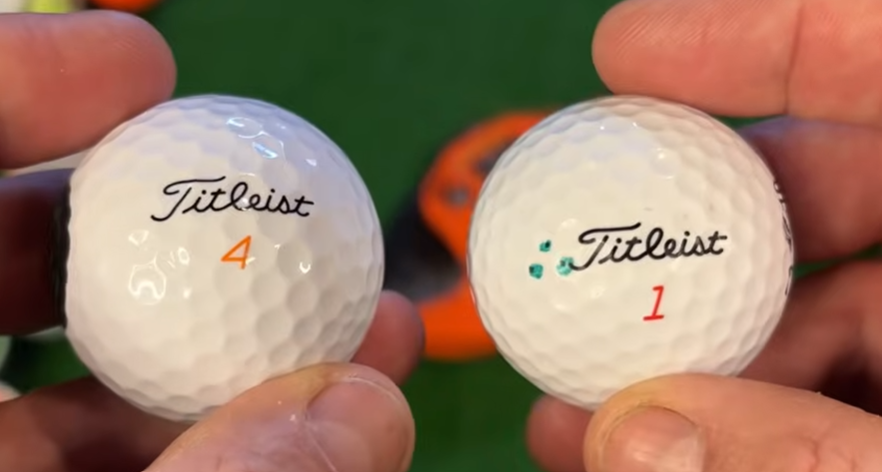
Two golf balls from Titleist. Titleist Velocity vs TruFeel golf balls. Both relatively affordable. Both designed for everyday golfers.
But there’s quite a big difference in what they’re promising.
The Titleist TruFeel is all about softness, while the Titleist Velocity is designed to give you more distance.
Titleist Velocity vs TruFeel golf balls. So which one should you actually be playing?
Well, I’ve got a confession.
I’ve never really been a fan of the TruFeel. Despite Titleist describing it as its softest golf ball, I’ve always found it feels a little harder than I’d like.
And I’ve got a few concerns about its durability, too.
But does that automatically make the Velocity a better golf ball?
Not necessarily.
I’ve been playing golf for over 30 years, and having cut open and reviewed more than 300 golf balls on my YouTube channel, Up Close Golf, I’ve learned one thing.
The golf ball that sounds best on the box isn’t always the one that works best for your game.
So let’s take a closer look at these two Titleist golf balls and see what actually separates them.
Titleist TruFeel vs Velocity: What’s the Difference?
Before we get Jeff involved, here’s a quick comparison.
And if you’re wondering who Jeff is, he’s my golf ball cutting tool.
My YouTube community actually named him after a poll on the channel, and he’s become something of a celebrity.
Which is quite an achievement for a tool that spends most of its life chopping golf balls in half.
Anyway, Titleist Velocity vs TruFeel golf balls here’s how the two balls compare.
| Feature | Titleist TruFeel | Titleist Velocity |
|---|---|---|
| Construction | 2-piece | 2-piece |
| Cover | TruFlex ionomer | Ionomer |
| Core | Low-compression core | High-speed core |
| Main selling point | Soft feel | Distance |
| Intended flight | Not the main selling point | Higher flight |
| Long-game spin | Designed for playable performance | Designed for low long-game spin |
| Greenside spin | Limited compared with premium urethane | Limited compared with premium urethane |
| Feel | Softer | Generally firmer |
| Price | Usually slightly cheaper | Usually slightly more expensive |
On paper, they’re pretty similar.
Both have a simple two-piece construction and an ionomer cover.
But Titleist has designed them with different priorities.
And that’s where things get interesting.
Titleist TruFeel Review: Is It Really That Soft?
Let’s start with the TruFeel.
Titleist describes this as its softest golf ball, designed to give golfers a softer sensation off the clubface, particularly when chipping and putting.
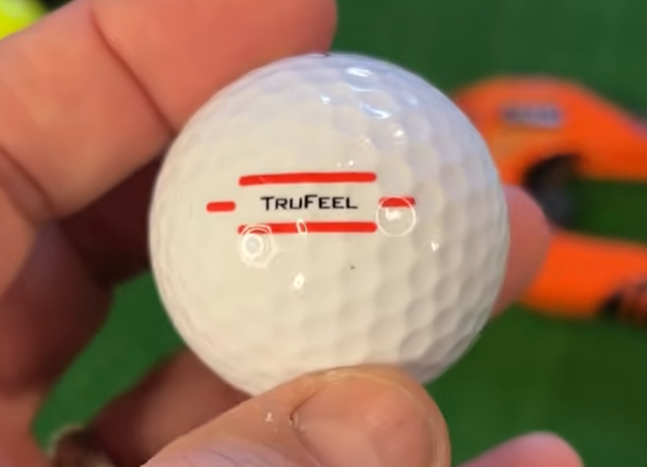
It has a low-compression core and a TruFlex ionomer cover.
Sounds pretty good, doesn’t it?
Well, here’s my problem.
I’ve played the TruFeel before, and I’ve never particularly liked how it feels.
Despite its name, I’ve always found it a little harder than I expected.
Now, I’m not saying Titleist is wrong to call it a soft golf ball.
Feel is incredibly personal.
What feels lovely and soft to one golfer might feel completely different to somebody else.
And that’s why I always encourage golfers to try different balls rather than simply choosing one because of the marketing.
My Experience With TruFeel Durability
There’s something else that’s bothered me about the TruFeel.
Durability.
In my own experience, I’ve found that the cover can mark up more easily than I’d like.
And that’s frustrating.
Because if you’re buying a relatively affordable golf ball, you want it to last.
There’s not much point saving a few pounds on a dozen balls if you’re constantly replacing them because the covers are damaged.
Of course, that’s just been my experience.
It doesn’t mean every TruFeel is going to have the same problem.
But it’s certainly something that’s put me off playing it regularly.
Cutting Open the Titleist TruFeel With Jeff
Now for my favourite part.
Getting Jeff involved.
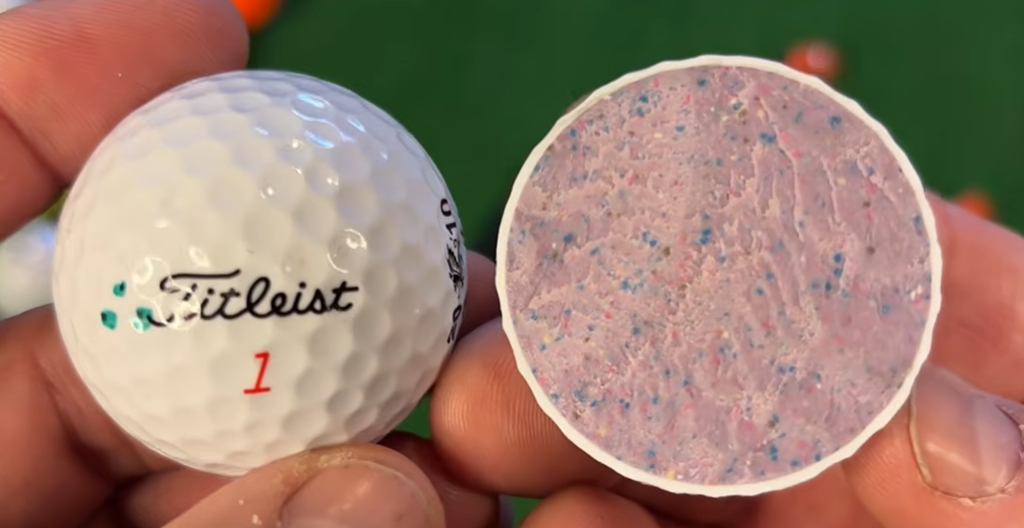
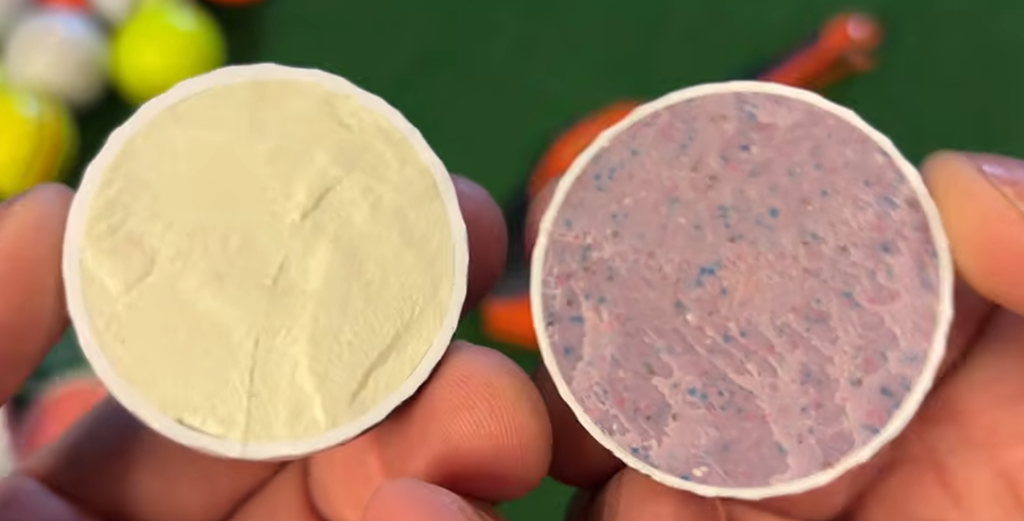
When you cut open the TruFeel, you find a fairly straightforward two-piece construction.
There’s a large central core surrounded by the outer ionomer cover.
And that’s it.
No complicated collection of mantle layers or different coloured materials.
Just a core and a cover.
But here’s something worth remembering.
A two-piece golf ball isn’t automatically an inferior golf ball.
Some very good distance balls use exactly this type of construction.
The challenge for manufacturers is balancing distance, spin and feel using those two components.
And although cutting a golf ball open helps us understand how it’s built, it doesn’t tell us everything about how it’ll perform.
I’m not a scientist. I’m just an average golfer who’s become rather obsessed with what’s inside these things.
And after cutting open hundreds of golf balls, I still find it fascinating how two balls that look almost identical on the outside can be engineered to behave differently.
Titleist Velocity Review: Built for Distance
Right, onto the Velocity.
This is a slightly different proposition.
While the TruFeel is marketed around softness, the Velocity is designed to produce high ball speed, a higher flight and low spin on longer shots.
In other words, Titleist wants this ball to help you squeeze out more distance.
And for plenty of golfers, that’s going to sound appealing.
Particularly if you struggle to get enough height on your drives or longer irons.
Like the TruFeel, the Velocity is a two-piece golf ball with a large core and an ionomer cover.
But it’s generally a firmer-feeling golf ball.
And that’s something you may notice, especially when you’re chipping or putting.
Titleist Velocity vs TruFeel golf balls: Does a Firmer Golf Ball Really Travel Further?
Here’s where I think golfers sometimes get a little confused.
Because a firmer golf ball isn’t automatically a longer golf ball.
I’ve tested plenty of golf balls over the years, including softer models that have travelled further than firmer, more expensive alternatives.
And that’s something I think gets overlooked.
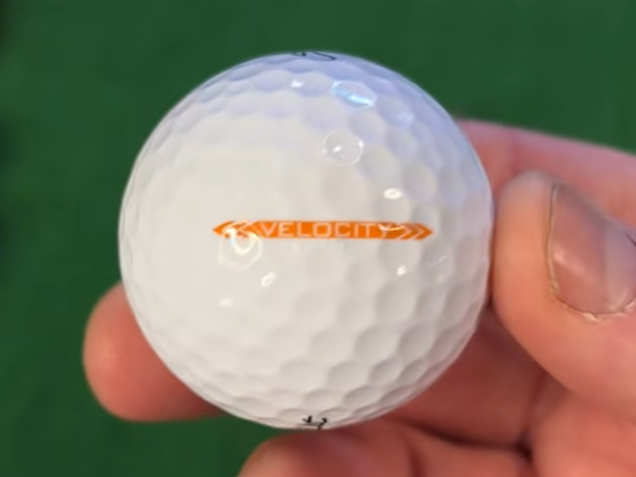
There’s a temptation to assume that if a ball feels harder, it must come off the driver faster.
But golf ball performance is more complicated than that.
Launch angle, spin, ball speed and how you deliver the club all influence the final result.
Titleist Velocity vs TruFeel golf balls. So although the Velocity is designed for distance, I wouldn’t automatically assume it’s going to travel further than the TruFeel for every golfer.
To establish that properly, we’d need to test both balls under the same conditions.
What’s Inside the Titleist Velocity?
Time for Jeff again.
Cut open the Velocity and, just like the TruFeel, you’ll find a two-piece construction.
A large core surrounded by an outer cover.
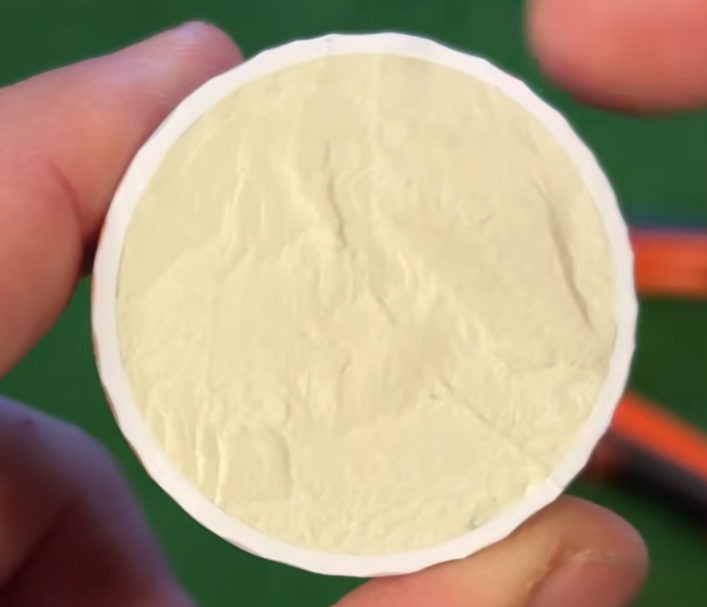
Nothing particularly complicated.
But don’t let that fool you.
Two golf balls can have the same number of layers and still behave quite differently.
The materials used in the core, the firmness of those materials, the cover formulation and even the dimple design can all influence performance.
And that’s why I enjoy cutting these balls open.
It’s a great way of seeing how they’re constructed.
But it’s only part of the story.
Just because two golf balls look similar inside doesn’t mean they’ll produce the same results on the course.
Titleist Velocity vs TruFeel golf balls: Which Is Longer?
This is probably the biggest question for golfers considering these two balls. Titleist Velocity vs TruFeel golf balls which one is longer?
And the Velocity certainly has the more obvious distance-focused design.
Titleist has engineered it to produce a higher flight and low spin on longer shots.
That combination could be useful for someone who needs a little more height or wants to optimise their driver performance.
But here’s the thing.
I’ve seen softer golf balls produce excellent distance in my own testing.
So I wouldn’t choose the Velocity purely because of its name.
Equally, I wouldn’t assume the TruFeel is going to be shorter just because it’s designed to feel softer.
Without a direct TrackMan comparison between these particular balls, there’s no reliable way for me to declare a distance winner.
And I’d rather tell you that than make up a few yards to make the comparison sound more exciting.
Titleist Velocity vs TruFeel golf balls: Which Golf Ball Has More Spin Around the Greens?
Now this is where things get interesting.
Because I think some golfers confuse soft feel with spin.
And they’re not the same thing.
Both the TruFeel and Velocity use ionomer covers.
And while those covers can provide perfectly usable short-game performance, they’re not designed to generate the same level of greenside spin as premium urethane-covered golf balls.
Think about something like the Pro V1.
Its urethane cover is one of the reasons it can offer such good control on shorter shots.
Neither the TruFeel nor Velocity is designed to replicate that exact performance.
So if you’re expecting the TruFeel to stop on a sixpence just because it’s called TruFeel, you might be disappointed.
For golfers who prefer to play bump-and-run shots or allow for a little rollout, that might not be an issue.
But if you rely on plenty of spin to stop your approach shots quickly, you may want to consider a different type of golf ball altogether.
And that’s why choosing the right cover material can be just as important as choosing the right compression.
Is the Titleist Velocity Worth Paying More For?
Generally speaking, the TruFeel tends to be slightly cheaper than the Velocity.
Although prices vary depending on where you’re shopping and what offers are available.
But personally, I wouldn’t let a small price difference decide which one to buy.
I’d be much more interested in how the ball actually performs.
If the Velocity gives you a better flight and a little more distance, then paying a few pounds extra could be worthwhile.
But if you prefer the softer feel of the TruFeel and you’re getting similar results, why spend more?
That’s really what Up Close Golf is all about.
Helping everyday golfers find a ball that works for them.
Not simply recommending the most expensive option.
And certainly not suggesting you need to play the same golf ball as your favourite tour professional.
My Verdict: Titleist Velocity vs TruFeel golf balls?
So, which one would I choose?
Well, personally, I’d lean towards the Titleist Velocity.
And that’s mainly because I’ve never been particularly impressed with the feel or durability of the TruFeel.
That doesn’t mean the Velocity is automatically the better golf ball.
If you enjoy a softer sensation when chipping and putting, the TruFeel could be exactly what you’re looking for.
And if you want a ball that’s designed to produce a higher flight and plenty of distance, the Velocity is certainly worth considering.
But I wouldn’t choose either one purely because of your handicap or swing speed.
And I definitely wouldn’t assume the firmer ball is going to travel further.
After more than 30 years playing golf, I’ve learned that what works for one golfer doesn’t necessarily work for another.
And that’s the bit I think golfers sometimes miss.
The best golf ball isn’t necessarily the softest, the longest or the most expensive. It’s the one that gives you the performance you actually need.
Not Sure Which Golf Ball You Should Be Playing?
If you’re still trying to work out which golf ball is right for your game, I’ve put together a free guide to help.
It’s based on the things I’ve learned from years of playing golf, testing different models and cutting open more than 300 golf balls.
You can download my free golf ball buying guide here.
And if you’d like to go a little deeper, I’ve also written a book called You’re Playing the Wrong Ball: The No Nonsense Guide to Choosing the Right Golf Ball for Your Game.
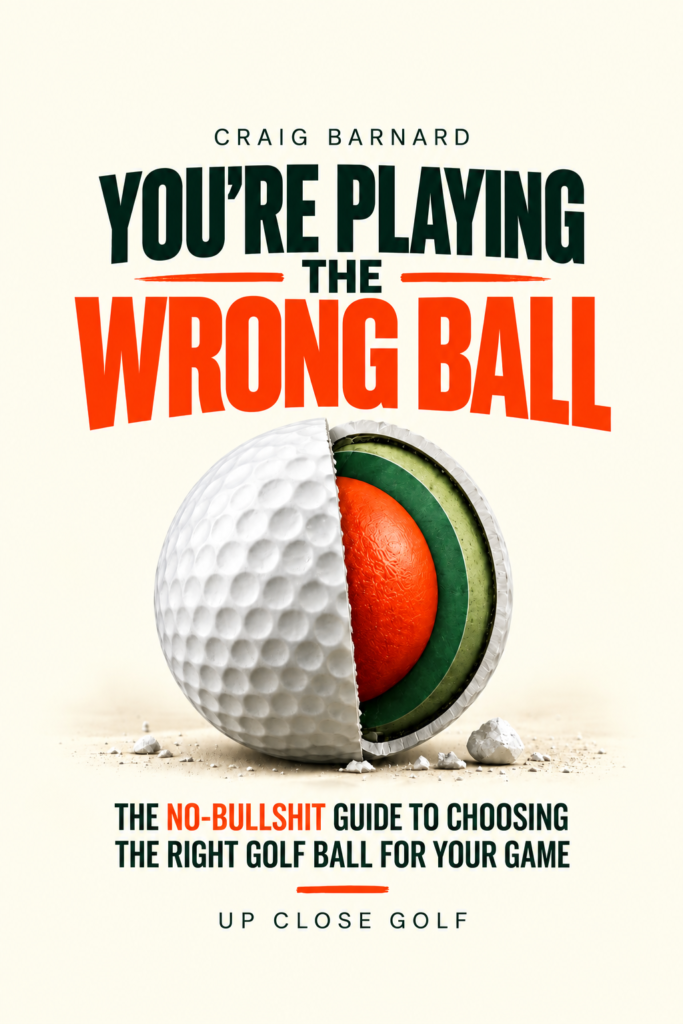
It’s my take on the golf ball myths, marketing claims and buying decisions that can make choosing a ball far more complicated than it needs to be.
If you fancy supporting the channel, you can also have a look at the Up Close Golf merch shop.
What Do You Think?
Now, I’d really like to know something.
Am I being a bit unfair on the Titleist TruFeel?
Have you played it and genuinely enjoyed the feel?
Or, like me, would you rather choose the Velocity?
Let me know in the comments below. I read every single one, and some of your suggestions have even inspired future Up Close Golf videos.
And if you haven’t already, make sure you check out the channel.
Jeff’s always got another golf ball waiting.
About the Author

Craig is the creator of Up Close Golf, where he’s cut open and reviewed more than 300 golf balls to help everyday golfers choose the right ball for their game.
He’s been playing golf for over 30 years and previously worked at one of the UK’s top-ranked golf courses. He’s also the owner of Fun Golf, a UK golf blog, and an Amazon bestselling golf author.
- Titleist TruFeel vs Velocity: Which Golf Ball Should You Actually Play?
- The Best Way to Clean Golf Balls? (I’ve Tried Everything!)
- 7 Wood vs 5 Wood: Making the Right Choice for Your Golf Game
- TaylorMade Tour Response vs Titleist Tour Soft — Which Should You Actually Play?
- 10 Best Golf Books Every Golfer Should Read!