
Titleist have just changed one of the strangest golf balls in their entire range.
The 2026 Titleist AVX.
It’s softer than a Pro V1. It’s designed to spin less. And it’s aimed at golfers who might want to squeeze a little more distance out of their game.
But I’ve always had one problem with the AVX.
If I’m spending premium Titleist money, why wouldn’t I just buy a Pro V1?
I’ll admit, that’s probably stopped me taking the AVX as seriously as I should over the years.
Because after looking more closely at the new 2026 ball, seeing how it performed in robot testing and, of course, getting Jeff involved and cutting it open, I think I might have misunderstood the AVX.
So, is the new Titleist AVX 2026 a KEEP?
Or should you DUMP it?

What Exactly Is the Titleist AVX?
The AVX has actually been around since 2018.
And it occupies a slightly strange position in the Titleist golf ball range.
It’s still a premium, three-piece urethane golf ball, but compared with the Pro V1 family the AVX has traditionally focused on three things:
- Softer feel
- Lower flight
- Lower long-game spin
That last one is particularly important.

The AVX was originally developed with more moderate swing-speed golfers in mind. Golfers who perhaps aren’t generating the speed they once did, but still want the benefits of playing a premium urethane golf ball.
Which, let’s face it, probably describes quite a few golfers.
And increasingly, probably quite a few of us who don’t want to admit it!
I’ve been playing golf for more than 30 years, and the older I get, the more I realise that choosing a golf ball shouldn’t be about playing whatever the best players use.
It should be about finding the ball that works for your golf swing.
That’s really what Up Close Golf is all about.
What’s Changed With the 2026 Titleist AVX?
Titleist haven’t completely reinvented the AVX.
From the outside, you could easily assume not much has changed at all.
Inside, though, there’s quite a bit going on.
Titleist have reworked the core to try to generate more speed.
They’ve also changed the casing layer to reduce long-game spin.
But there’s a problem with doing that.
Reduce spin too much throughout the entire golf ball and you risk losing some of the performance you actually want around the greens.
So Titleist have made the urethane cover thicker and softer to try to maintain that short-game spin.
Basically, the idea is:
More speed.
Less long-game spin.
But keep the spin where you actually need it.
There’s also a new aerodynamic package designed to maintain that lower, more penetrating AVX ball flight.
It sounds great.
But golf ball marketing always sounds great.
The important question is whether any of it actually makes a difference.
Titleist AVX YouTube Review
The Robot Testing Makes the AVX Interesting
This is where my opinion of the AVX started to change.
MyGolfSpy recently tested 48 different golf balls using robot testing at three different swing speeds, using drivers, irons and wedges.
And the AVX performed well.

At their mid swing-speed test of around 102mph, the AVX was actually selected as one of their recommended mid-spin golf balls.
I think that matters because there’s still a perception that the AVX is basically a super-soft golf ball designed for slow swing speeds.
It isn’t.
Its measured compression was in the high 70s.
So yes, it’s soft compared with other premium Titleist balls such as the Pro V1, Pro V1x and Left Dash.
But we’re not talking Callaway Supersoft levels of softness here.
This is still a proper premium urethane golf ball.
And if you’re someone who generates too much driver spin, that lower-spin profile starts to make quite a lot of sense.
So Why Wouldn’t I Just Buy a Pro V1?
This was the big question for me.
And I think I’ve been looking at it the wrong way.
The AVX isn’t supposed to be a cheaper Pro V1.
It’s not really supposed to be a softer Pro V1 either.
It’s a different golf ball designed to do a different job.
If you already hit your driver at a good height, your spin is under control and you’re getting the distance you want, then the Pro V1 might be absolutely perfect.
But what if you hit the ball too high?
What if you generate too much spin?
What if you’re starting to lose a little speed?
Suddenly the AVX becomes much more interesting.
The idea is to bring that flight down, reduce some long-game spin and potentially squeeze a little more distance out of the speed you’ve already got.
But you’re still getting that urethane cover when you get closer to the green.
And that is where I can see the appeal.
Time to Get Jeff Involved
Of course, Titleist can tell us they’ve changed everything inside the golf ball.
But there’s only one way we’re going to find out.
Jeff.
If you’re new to Up Close Golf, Jeff is my golf ball cutting tool.
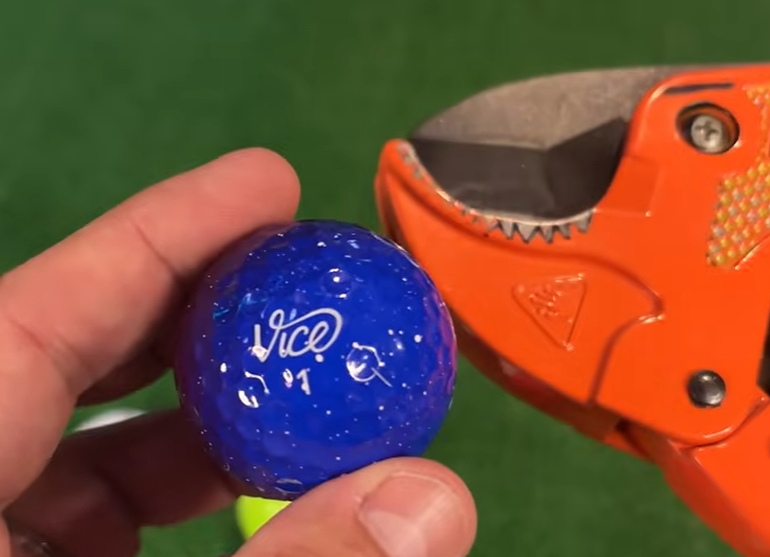
Yes, he has a name.
I ran a poll with the Up Close Golf community asking what we should call him. Jeff won, and somehow he’s since developed a bit of a cult following on the channel.
I’ve now personally cut open and reviewed more than 300 golf balls, and I still love seeing what manufacturers have actually put inside them.
I’m not a scientist.
I’m just a golfer who’s played for more than 30 years, spent several years working at one of the UK’s top-ranked golf courses when I was younger, and has become slightly obsessed with golf balls.
And I’ve learnt a huge amount along the way.
For this test, I had something particularly useful.
An older AVX that Jeff had already cut open.
That meant we could cut the brand-new 2026 AVX and put the two generations directly alongside each other.
And you can immediately see that these aren’t identical golf balls.

The older AVX has that distinctive brownish-looking internal construction, while the new version looks noticeably different.
That ties in with what Titleist are telling us.
The core has been reworked.
The casing layer has changed.
And the urethane cover is now thicker and softer.
Can I look at two halves of a golf ball and tell you exactly how many RPM of spin those changes are going to produce?
Of course not.
But after cutting open hundreds of golf balls, I find these comparisons fascinating.
You can actually see that something has changed rather than simply taking the manufacturer’s word for it.
What About Feel and Performance?
This is where choosing the right golf ball gets very personal.
I’ve tested enough golf balls on the course over the years to know that there’s no single “best golf ball” for everybody.
Feel matters.
Flight matters.
Spin matters.
Your swing matters.
Even what you like hearing and feeling off the putter matters.
The AVX is particularly interesting because it offers that softer premium feel without going all the way into the really soft golf ball category.
You’re also getting a urethane cover, which is important if you still want greenside control.
And that’s the trade-off I find interesting.
There are plenty of softer balls out there.
There are plenty of low-spin distance balls.
There are plenty of premium urethane balls.
The AVX is trying to combine elements of all three.

I Think I’ve Misunderstood the AVX
This is probably my biggest takeaway from this Titleist AVX 2026 review.
I’ve misunderstood this golf ball.
For years, I’ve looked at it and thought:
Why wouldn’t I just buy a Pro V1?
But that misses the point.
If a Pro V1 gives you exactly the flight, spin and distance you need, then brilliant.
Buy the Pro V1.
But if you need to knock some spin off your driver, bring your flight down or potentially find a little more distance from the swing speed you already have, the AVX gives you another option.
It isn’t trying to beat the Pro V1.
It’s trying to solve a different problem.
And that’s something I think more golfers need to consider when choosing a ball.
Don’t automatically buy the golf ball you’re supposed to play.
Try different brands. Try different constructions. Try different compression levels.
You might be surprised by what actually works best for your game.
Titleist AVX 2026: KEEP or DUMP?
So…
KEEP or DUMP?
I’m going KEEP.

It’s not for everybody.
And I’m certainly not saying keep it simply because it has Titleist written on the side.
But I think the new AVX makes a lot of sense for the golfer it’s designed for.
You’re getting:
- A softer premium feel
- Lower long-game spin
- A more penetrating flight
- A urethane cover for greenside performance
- A redesigned construction aimed at producing a little more speed
And for the right golfer, I genuinely think the 2026 Titleist AVX could be a better fit than the Pro V1.
I didn’t think I’d be saying that when I started looking into this ball.
But that’s why I love doing these tests.
Sometimes the golf ball you’d previously ignored might actually be exactly the sort of ball you should be trying.
- 7 Wood vs 5 Wood: Making the Right Choice for Your Golf Game

- TaylorMade Tour Response vs Titleist Tour Soft — Which Should You Actually Play?
- 10 Best Golf Books Every Golfer Should Read!
- Callaway Supersoft vs Wilson Duo Soft: I Tested Both!
- Titleist AVX 2026 Review: Better Than a Pro V1?



What Do You Think?
Have you played the Titleist AVX?
I’d particularly like to hear from anyone who’s moved from a Pro V1 to an AVX.
Did you notice the lower flight or spin? Did you gain any distance? And, most importantly, would you choose the AVX again?

Let me know your thoughts in the comments.
You can also get my free golf ball buying guide if you’re trying to work out which type of ball might suit your game.
And if you want to support Up Close Golf — or just fancy something with Jeff on it — you can check out the Up Close Golf merch store.
Jeff and I will catch you in the next one.
About Craig

Craig is the creator of Up Close Golf, where he’s cut open and reviewed over 300 golf balls to help average golfers choose the right ball for their game.
He’s been playing golf for over 30 years and previously worked at one of the UK’s top-ranked golf courses. He’s also the owner of Fun Golf, a top-ranked UK golf blog, and an Amazon best-selling golf author.