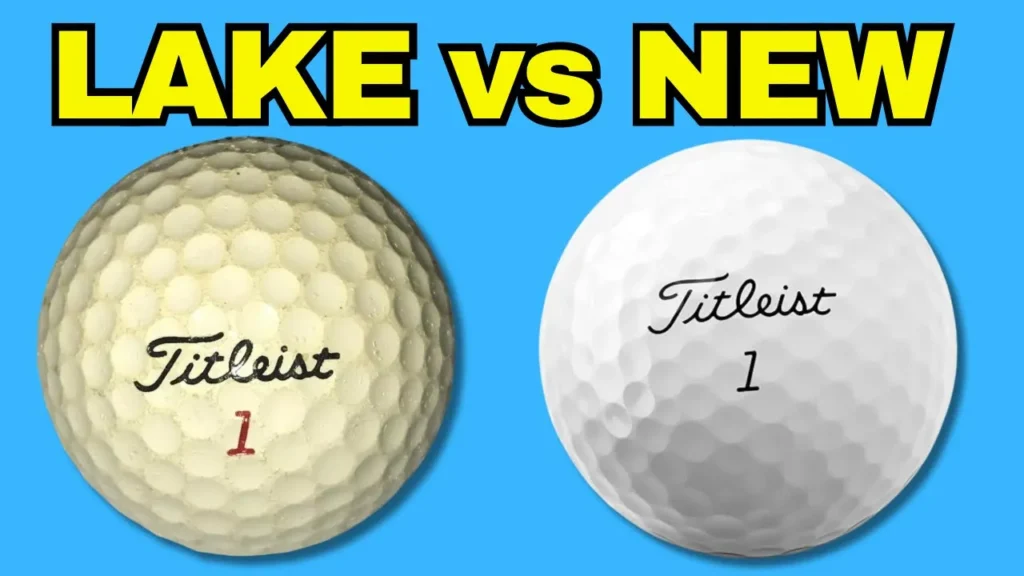

TaylorMade Tour Response vs Titleist Tour Soft.
Two golf balls aimed pretty squarely at golfers like you and me.
Neither is a Pro V1. Neither costs £50 a dozen. And on the face of it, they’re both trying to give you plenty of performance without making you remortgage the house to buy a box of golf balls.
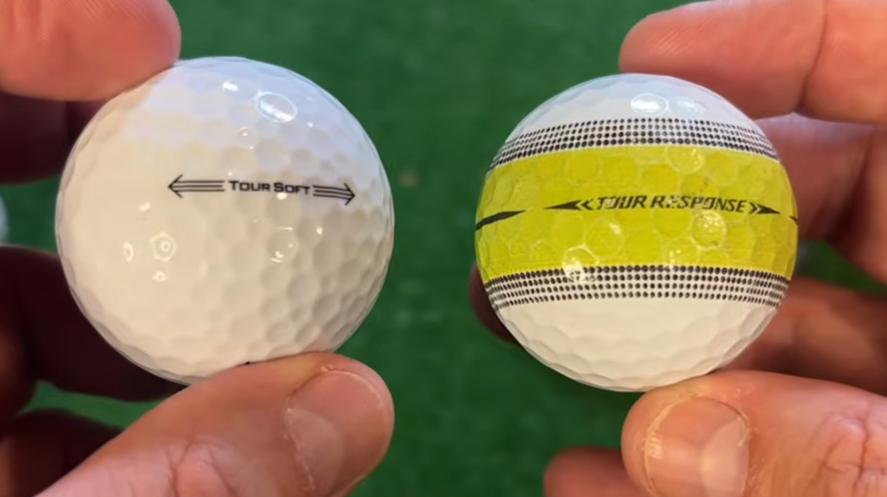
But there’s a pretty big difference between them.
The TaylorMade Tour Response has a urethane cover.
The Titleist Tour Soft has an ionomer cover.
So does that actually matter?
Well, I’ve played both. And I actually found one of them felt better, went further and gave me tighter dispersion.
So, as usual, I got Jeff involved.
If you’re new here, Jeff is my trusty golf ball cutting tool. He’s actually got something of a cult following on the UpCloseGolf channel after I named him following a community poll.
He’s cut open well over 300 golf balls with me now.
And yes, he’s still going strong.
So let’s see what’s actually inside these two and whether the testing backs up what I found on the course.
TaylorMade Tour Response
Let’s start with the TaylorMade Tour Response.
This is a really interesting golf ball because it isn’t your typical cheap two-piece distance ball.
It’s a three-piece golf ball with a urethane cover.
And that’s important.
Urethane is generally used on premium golf balls because it can give you more greenside control and spin.
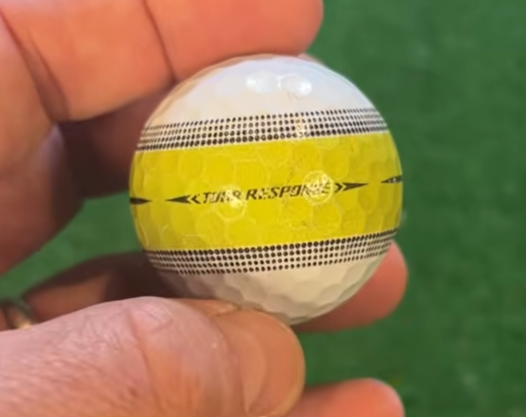
So inside the Tour Response you’ve got:
- A soft-ish core
- A mantle layer
- A urethane outer cover
TaylorMade are basically trying to give golfers some of the benefits of a premium golf ball without charging the full premium-ball price.
And I’ve played this ball quite a bit.
Personally, I really like it.
I found it felt really good off the club and, when I compared it with the Tour Soft on the course, I felt I was getting more distance off the tee.
I also felt my shots were more consistent, with tighter dispersion from both the driver and irons.
Now, that’s just my experience.
I’m not saying you’re automatically going to see the same thing.
But it’s exactly why I wanted to put these two golf balls head-to-head.
So what does Jeff find?
Well…
Let’s get him involved.
I’ve personally cut open more than 300 golf balls now, and there’s something I never get bored of about seeing what’s actually underneath the cover.
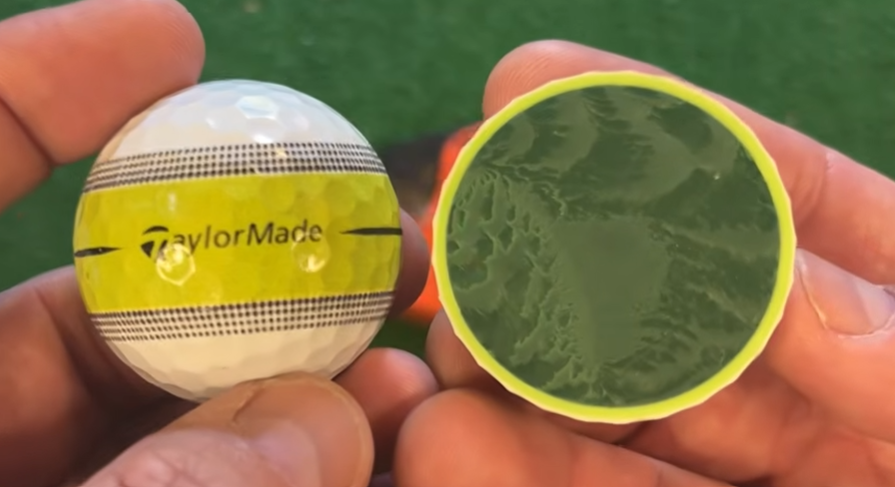
And there we go.
Three-piece construction.
Big core. Mantle. Urethane outer layer.
You can actually see just how much of the ball is taken up by that core.
And this is what you’re paying for when you buy something like the Tour Response.
You’re not just paying for the TaylorMade logo.
There’s a completely different construction going on inside.
But now we need to bring in the Titleist.
Titleist Tour Soft
This is the 2026 Titleist Tour Soft.
And this is where things get interesting.
Because despite the name…
this isn’t actually a particularly soft golf ball.
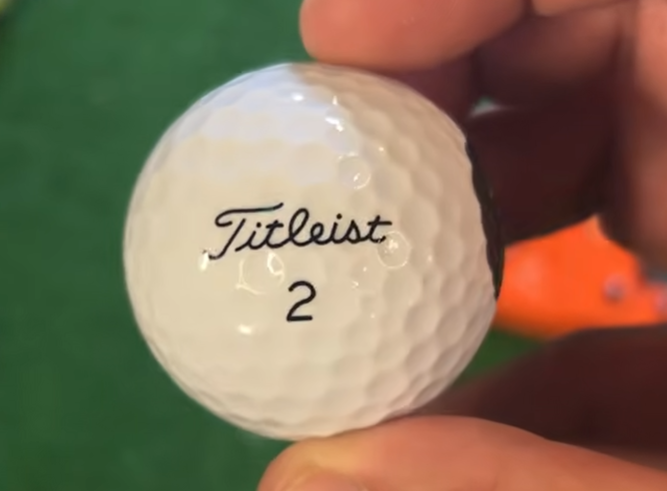
MyGolfSpy measured the previous Tour Soft at around 88 compression.
That’s actually around the same sort of territory as a Pro V1.
So don’t look at the word “Soft” and assume this is some ultra-soft, slow golf ball.
It isn’t.
Titleist has redesigned the ball for 2026.
It’s still a two-piece ionomer-covered golf ball, but both the core and cover have been changed.
The core is slightly smaller.
The cover is thicker and softer.
And Titleist are trying to do something quite clever here.
Reduce long-game spin while maintaining a high flight and still giving you some control around the greens.
And MyGolfSpy found this ball was actually one of the longer balls they tested off the tee.
Which is pretty interesting for a two-piece golf ball.
So is the Tour Soft actually closer to a premium golf ball than we might think?
Well…
There’s only one way to find out.
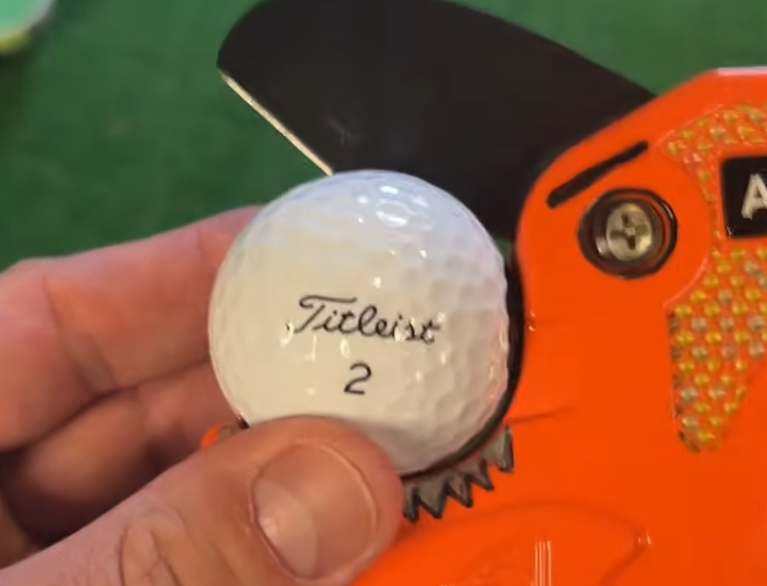
Cutting open the Tour Soft
Right.
Let’s cut this one open.
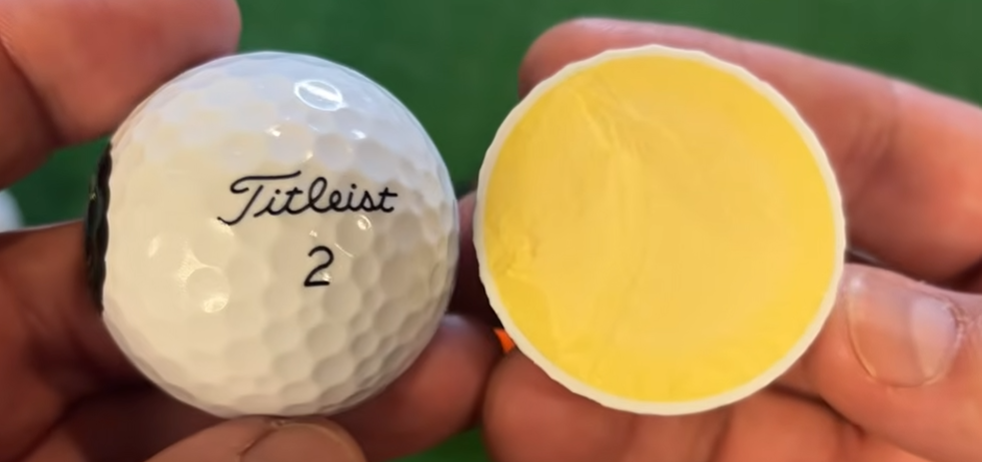
And…
there we go.
Now that’s interesting.
Because when you compare the two, you can immediately see that we’re dealing with a very different construction.
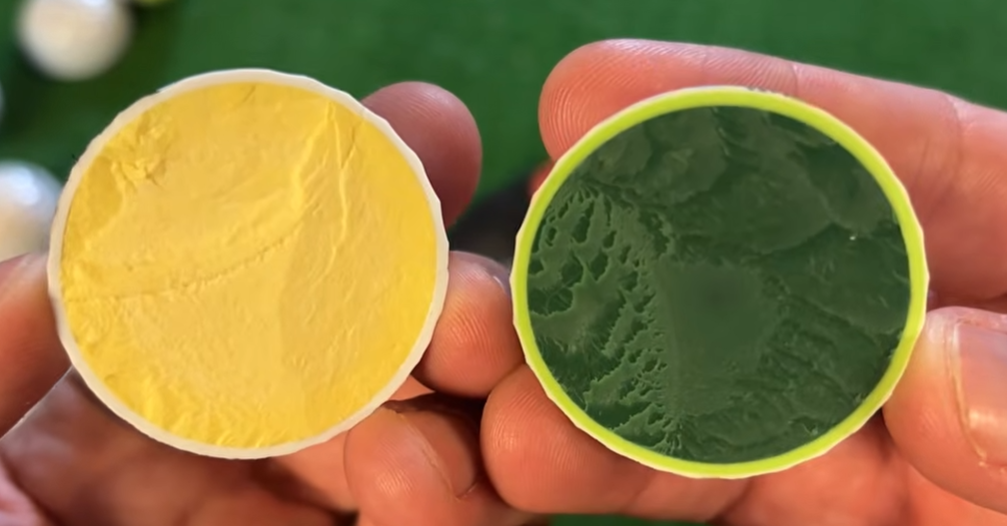
Tour Response:
Three-piece.
Urethane.
Two-piece.
Ionomer.
And normally you’d look at that and think:
Well, surely the Tour Response is going to win?
But…
not necessarily.
And this is exactly why I like doing these golf ball reviews.
You can look at the construction and make an assumption.
But the golf ball still has to perform.
What does the testing say?
This is where I really like looking at the MyGolfSpy testing.
They don’t just hit one shot with each golf ball and declare a winner.
They test them at different speeds, with different clubs, and look at things like ball speed, distance, launch and spin.
And the results here are actually pretty interesting.
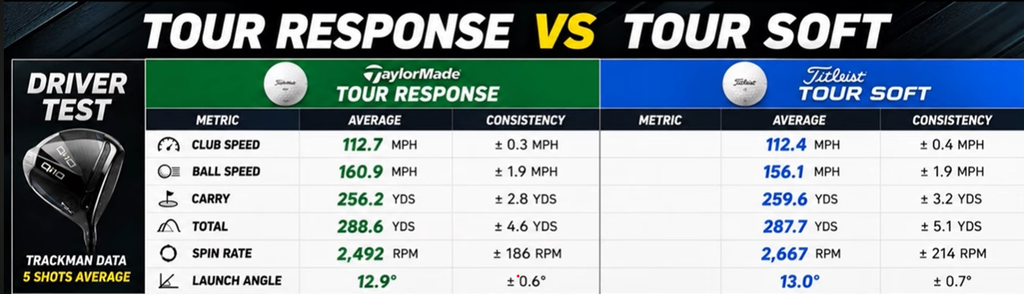
On the driver testing shown here:
- Tour Response: 148.3 mph ball speed
- Tour Response: 256.2 yards carry
- Tour Soft: 149.7 mph ball speed
- Tour Soft: 259.6 yards carry
So, on those numbers, the Tour Soft was actually a little faster and carried a little further.
But then look at total distance.
Tour Soft: 287.7 yards
Basically…
nothing in it.
And that’s an important point.
Because if somebody tells you one of these is simply “the longer golf ball”, the data doesn’t really support such a simple conclusion.
There’s barely anything between them in total distance.
And that’s something I’ve found again and again from looking at golf ball testing.
The differences can be much smaller than the marketing sometimes makes you think.
And then there’s the wedge
This is where I think things get really interesting.
Because once we get closer to the green, the construction starts to matter more.
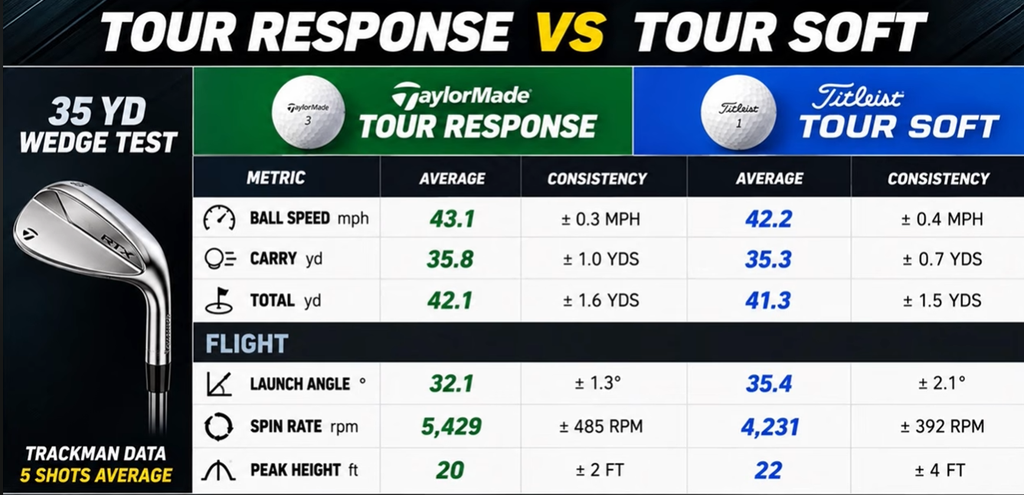
On the 35-yard testing, the Tour Response produced around 5,429 rpm of spin.
The Tour Soft was at around 4,231 rpm.
That’s roughly a 1,200 rpm difference.
And that’s where the urethane cover starts to earn its keep.
The Tour Soft can get surprisingly close to a premium golf ball in some situations.
But it isn’t a urethane ball.
And there are always going to be trade-offs.
That’s not necessarily a criticism of the Tour Soft.
It’s just what happens when you’re comparing two completely different constructions.
What did I think on the golf course?
This is the bit I’m always interested in.
Because numbers are great.
But eventually I want to actually take the golf ball out and play it.
I’ve been playing golf for more than 30 years, and I’ve spent years around the game, including several years working at a top-ranked UK golf course when I was younger.
I’ve also now cut open and reviewed more than 300 golf balls.
But I’m not a scientist.
I’m an average golfer who’s fascinated by golf balls and wants to understand them better.
And I’m learning just like you are.

So what did I find?
Personally…
I preferred the Tour Response.
It felt better to me.
I found it more responsive off the club and I felt like I was getting more distance off the tee.
But what really surprised me was the dispersion.
With both driver and irons, I felt like I was getting tighter results with the Tour Response.
Again, I’m not pretending my testing is some sort of scientific study.
It isn’t.
I’m one golfer.
Your results could be completely different.
But that’s exactly why I think personal testing matters.
Because the question isn’t simply:
Which ball won the robot test?
The question is:
Which ball works for you?
So which golf ball should you play?
Let’s make this simple.
If you want a high-launching, distance-focused golf ball and you’re happy with an ionomer cover, the Titleist Tour Soft is really interesting.
Especially because it doesn’t behave like the cheap two-piece golf balls you might automatically associate with that construction.
It’s capable of very good distance and Titleist have clearly tried to squeeze a lot of performance out of the two-piece design.
But if you want a urethane cover, more greenside spin and the feel of something a little more premium, the TaylorMade Tour Response gives you a lot of that without jumping all the way up to premium-ball prices.
And for me…
I’d play the Tour Response.
Not because TaylorMade says it’s better.
Not because the construction looks more impressive when Jeff cuts it open.
And not because MyGolfSpy says anything in particular.
I’d play it because I actually preferred playing it.
And that, for me, is probably the biggest lesson here.
Don’t get obsessed with the construction
Golfers can get a bit obsessed with the numbers.
Two-piece.
Three-piece.
Urethane.
Ionomer.
Compression.
Spin.
Launch.
And yes, all of those things matter.
But they’re not the whole story.
The Tour Soft is a great example.
It’s a two-piece ionomer golf ball, but it’s firmer than you might expect, it’s capable of very good distance and Titleist have clearly tried to get as much performance as possible from that construction.
Then you’ve got the Tour Response.
Three-piece.
Urethane.
More greenside spin.
And a more premium feel.
But without going all the way up to the price of a premium tour ball.
So rather than asking:
“What’s the best golf ball?”
I think there’s a better question.
“What am I actually trying to get from my golf ball?”
More distance?
More control?
Softer feel?
More greenside spin?
Or maybe…
just something that doesn’t cost a fortune?
That’s really what I’m trying to do with UpCloseGolf.
I don’t want to tell you that you need to play a Pro V1.
I want golfers to try different brands and different golf balls and actually find something that suits their game.
And sometimes that might be a £50-a-dozen ball.
But sometimes it might not.
That’s the fun of it.
Want help finding the right golf ball?
This whole subject is actually what inspired me to write my book, You’re Playing the Wrong Ball – The No-Bullshit Guide to Choosing the Right Golf Ball for Your Game.
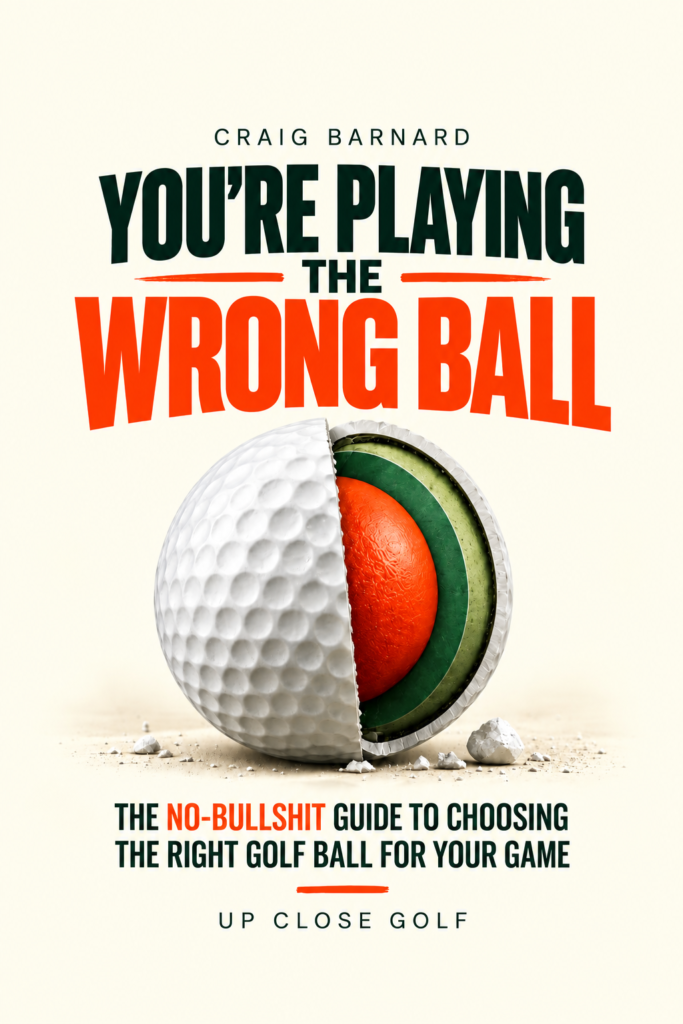
It’s basically everything I’ve learned from cutting open hundreds of golf balls, testing them and trying to make sense of all the marketing nonsense that surrounds them.
You’re Playing the Wrong Ball – my golf ball book
And if you don’t fancy buying a book just yet, I’ve also put together a free Golf Ball Buying Guide.
It’s designed to help you narrow down what sort of golf ball might suit your game based on things like your swing speed and what you’re actually looking for from the ball.
Get my free Golf Ball Buying Guide
The whole point is simple.
Stop wasting money on the wrong golf ball.
Final verdict
So…
TaylorMade Tour Response or Titleist Tour Soft?
For me, it’s the Tour Response.
But that doesn’t mean you should automatically go out and buy it.
If the Tour Soft gives you the feel, launch, distance and performance you want, then brilliant.
That’s the whole point.
Golf balls are incredibly personal.
And after cutting open more than 300 of them, testing loads of different models and playing golf for more than 30 years, I’m still finding things that surprise me.
That’s why Jeff and I keep cutting them open.
And why I’ll keep trying different golf balls.
If you’ve played both the TaylorMade Tour Response and Titleist Tour Soft, I’d genuinely love to know what you thought.
Could you actually tell the difference?
Which one would you play?
Drop a comment below and let me know.
And if you want to check out some UpCloseGolf gear, you can find it in the UpCloseGolf merch shop too.
Visit the UpCloseGolf merch shop
Thanks for reading, and I’ll see you in the next one.
- 7 Wood vs 5 Wood: Making the Right Choice for Your Golf Game
- TaylorMade Tour Response vs Titleist Tour Soft — Which Should You Actually Play?
- 10 Best Golf Books Every Golfer Should Read!
- Callaway Supersoft vs Wilson Duo Soft: I Tested Both!
- Titleist AVX 2026 Review: Better Than a Pro V1?
About Craig

Craig is the creator of UpCloseGolf, where he’s cut open and reviewed over 300 golf balls to help golfers choose the right ball for their game.
He’s also the owner of Fun Golf, a top-ranked UK golf blog, and an Amazon best-selling golf author.